The way we grow food is changing. Many of the synthetic chemicals that farmers and growers relied on are being phased out or no longer work as efficiently as they used to. Our soils offer solutions - microbes that have evolved over millions of years to combat pests in the ground. However, finding the right microbe with the ability to replace synthetic chemicals has relied on chance.
In his search for new antibiotics for human health, academic scientist Jeremy Owen realised he was onto something important after a set of experiments came back with stronger than expected results. He realised there was a faster, more cost-effective way to scan large amounts of microbial DNA and read their genetic code to find powerful crop inputs. It was research that felt too important to leave in a paper or a lab.
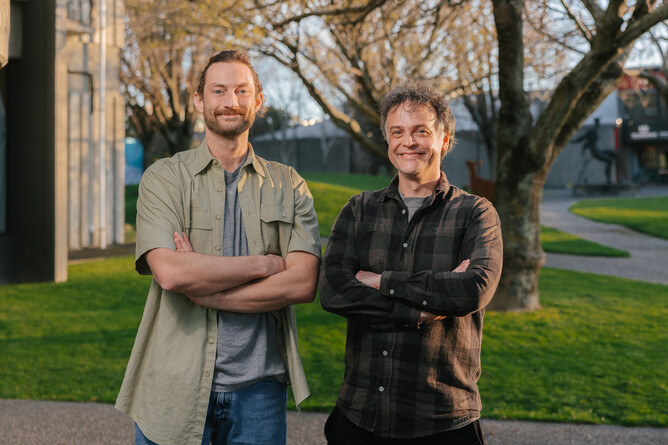
Meet the founders of Gifted Microbes, one of the ventures taking part in the Sprout Accelerator Spring25 Cohort. The venture is a project from within Victoria University of Wellington | Te Herenga Waka, supported by Wellington UniVentures. Jeremy, a scientist who bridges chemistry, biology, and bioinformatics, is the CSO, and Sam Wojcik is the CEO and commercial lead, liaising with industry, shaping IP, and developing a go-to-market strategy. Together, they balance focus with curiosity and a healthy dose of banter, sharing a simple motivation to give growers better tools as old ones fade.
Their solution offers a genetic-first discovery platform for high-impact agricultural microbes. It’s a reproducible, lower-cost method for reading new microbial genomes at a far greater scale, with the ability to then zero in on the “gold nuggets” with the genetic capacity to produce specific compounds - their gifted microbes. Instead of starting with a shelf of known strains and hoping for the best, they define the problem - like a stubborn fungal disease - and what a winning molecule would look like, and then deliberately search for microbes wired to make it. That shift from chance discovery to targeted identification is the heart of Gifted Microbes’ approach.
A key insight shaped this approach, as with many “microbial” products, it’s the metabolites made during fermentation that do the work, not the live microbe itself.
Like most entrepreneurial journeys, it hasn’t been a straight line. Early on, Jeremy and Sam explored alternative applications, but conversations with growers made the agricultural need impossible to ignore. Seeing exciting data from the lab and hearing how few options growers have pushed them toward crop protection, especially safer, more consistent biofungicides. Both founders are also community-focused. For Jeremy, the pull is also about growing science in Aotearoa, he wants to contribute to an ecosystem that creates real jobs and delivers homegrown products to growers. For Sam, success is impact at scale, which in turn also benefits New Zealand.
As part of the Sprout Accelerator Spring25 Cohort, Gifted Microbes is focused on proving what the platform can do and turning it into outcomes. Their next milestone is to show they can find and develop the right biochemical to treat fungal diseases affecting growers globally. Commercially, they’re sharpening the pitch, securing IP and preparing to raise capital.
Meet Gifted Microbes, they’re turning clever science into the tools that farmers and growers need to grow.