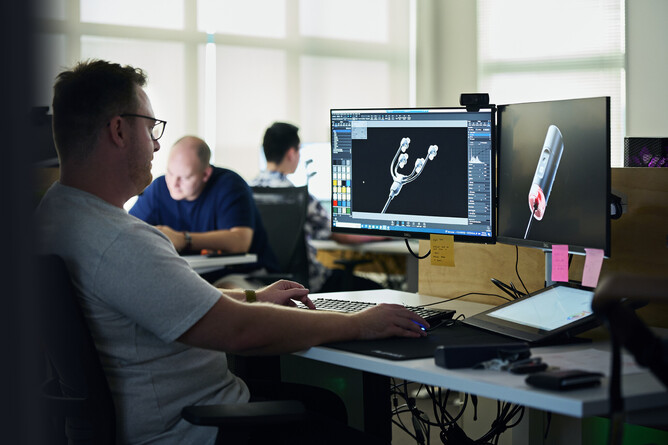
Bringing a new product to life is never easy, especially in the world of agritech and biotech, where ideas often begin on the farm or in the lab. The journey from concept to commercial product is filled with technical unknowns, competing priorities, and decisions that can make or break a startup’s ability to scale. For founders in the Sprout Accelerator programme, having the right support can make all the difference.
That’s where Sprout Founder Support Partner, Blender plays a key role. As a product design and development consultancy, Blender works with early-stage startups to turn promising concepts into scalable, manufacturable products. Co-founder Oliver McDermott and his team provide hands-on support with product strategy, technical feasibility, early manufacturing planning, and investor readiness – helping founders move faster, avoid costly missteps and build with confidence.
We caught up with Oliver to hear how this partnership works in practice, and why getting the early-stage thinking right is so critical to building a product that’s ready for the real world.

Getting help early makes a difference
Startups coming through the Sprout Accelerator often have a strong foundation: a clear problem, a working prototype, and deep insight into their domain. Some are backed by years of research. Others are driven by hands-on experience in the field.
But as Oliver explains, turning a smart idea into a viable product – and a business that can scale – takes more than technical validation. It also demands strategic thinking, forward planning, and a clear understanding of how the product will be used, built, and funded.
“The sooner we’re in the room, the more we can help,” says Oliver. “We’re often working with scientists or engineers who’ve built something that works in a test environment. Our job is to help them figure out how to make it work in the hands of a real user, and in the context of a real business.”
From ambiguity to action
Early product development can be messy. There’s energy and ambition, but also ambiguity. Founders are often juggling multiple unknowns at once: users, features, costs, risks, and manufacturing. Getting clarity early makes everything downstream easier.
That clarity starts with asking the right questions: Who are the stakeholders? What are their needs? What exactly does the product need to do? What are the technical risks? What will it take to build and deliver it at scale?
Oliver explains that to help answer those questions, the Blender team works through a structured early-stage process that leads to a practical, investor-ready Product Development Plan.
“It’s about building a roadmap to revenue,” he says. “One that identifies risks early, lines up the right people, and gives everyone a clear view of the next steps.”
“We don’t just help to define the product,” says Oliver. “We help to define the approach – how to develop it, build it, fund it, and scale it.”
Whatever the pathway, the goal is the same: to help founders make informed decisions early and build the foundations of a product that’s ready for the real world.
Planning with purpose and precision
One of the hurdles early-stage startups face is raising capital. Investors don’t just want to see a promising idea. They want evidence that the team understands what they’re building, who it’s for, how it will be made, and where the risks lie.
This is where Blender’s structured process and new product development experience gives founders a real advantage. A Product Development Plan becomes more than a technical document. It’s a tool for alignment, communication, and momentum. It helps teams articulate their vision clearly – backed by evidence, insight, and a practical roadmap.
“A good plan helps answer questions investors are already asking,” says Oliver. “What’s it going to cost? How long will it take? What could go wrong, and how are you planning for that? We help founders get ahead of those questions and answer them with confidence.”
The plan often includes supporting visuals and documentation that can slot directly into a pitch deck. That might include product renders, staged budgets, risk registers, production costings, or technical roadmaps – all designed to reduce ambiguity and demonstrate a clear pathway to in market.
Avoiding wrong turns
In early-stage product development, it’s easy to lose time chasing the wrong detail. Whether it’s building a feature that won’t scale, solving the wrong problem, or designing something that’s too expensive to manufacture, early missteps can slow progress and dilute value.
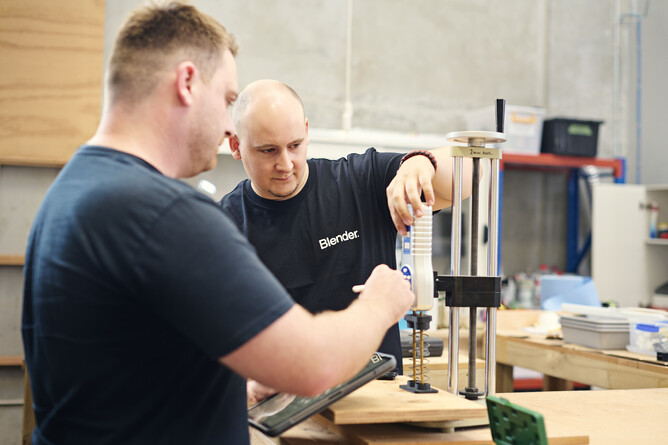
That’s where experienced support can make a difference. By combining strategic thinking with hands-on engineering and manufacturing knowledge, Blender helps founders stay focused on what matters and avoid costly wrong turns.
“This isn’t just about speed,” says Oliver. “It’s about making smart calls early – testing assumptions before investing heavily, identifying failure points, and planning for the real-world constraints of production, not just the ideal version of the product.”
That includes knowing when to simplify. “The number 8 wire mentality gets us a long way,” he says, “but it doesn’t always get us to market. Founders shouldn’t be trying to do everything themselves. We want to help them focus on what they do best and what is most important – whether that’s the science, software or customer relationships – while we support the product development.”
Supply chain thinking is an important part of that support, and it is too often overlooked or left too late in the product development process. “We consider supply chain strategy early because it shapes how the product is made: over 70% of a products cost it determined in the early stages of product development” Oliver explains. “The earlier we think about manufacturing, the faster we can get to market, and the less chance we’ll need to undergo costly redesign later when it comes time to scale.”
Building with purpose
Every agritech startup faces uncertainty. The market is complex, the technology is evolving, and the stakes are high, not just for the business, but for the land, people, and systems the product is designed to support.
Blender’s approach is grounded in partnership. They don’t just offer technical expertise or design support. They work closely alongside founders to build clarity, momentum, and confidence. It’s a collaborative process, shaped by curiosity, challenge, and shared ambition.
Oliver explains that it’s what makes the relationship with Sprout so valuable. Both organisations are invested in helping early-stage companies do the hard thinking early, build what matters, and bring bold ideas into the world with care and intent.
“Sprout helps to bring in the right people at the right time,” he says. “It’s not just about funding or advice. It’s about surrounding founders with the support they need to move faster, test smarter, and build something that lasts. We’re proud to be part of that ecosystem.”
For founders, it means knowing you’re not building alone, and that every step forward is part of a bigger journey.
To learn more about how Blender supports early-stage product development, visit blender.nz or get in touch with the team.