Reflections from the Innovate UK 2026 Global Incubator Programme's First New Zealand Visit, Hosted by Sprout.
There's a particular kind of learning that only happens on the ground.
You can read every export statistic, watch every webinar, and study every market report. But nothing quite prepares you for standing among 30 year old vines in a kiwifruit orchard in the Bay of Plenty; listening to a farmer explain why they are open to adopting technology in the milking shed; or sitting in a methane chamber at Bioeconomy Science Centre, listening to a scientist describe measuring a single cow's emissions to the gram.
That's the experience our first cohort of UK agritech innovators just had. Over two weeks across Auckland, the Waikato, Bay of Plenty, Manawatū and beyond, six businesses arrived through the Innovate UK 2026 NZ Global Incubator Programme to do exactly what the name suggests, to explore the market.
This is the first time this programme has run in New Zealand, delivered in partnership between Innovate UK and Sprout Agritech.
As Sprout CEO Sandhya Sriram likes to say,
“The future of food won't be solved by any one country working alone.”
This visit was a real test of that philosophy, and the insights from the cohort were more interesting than expected.
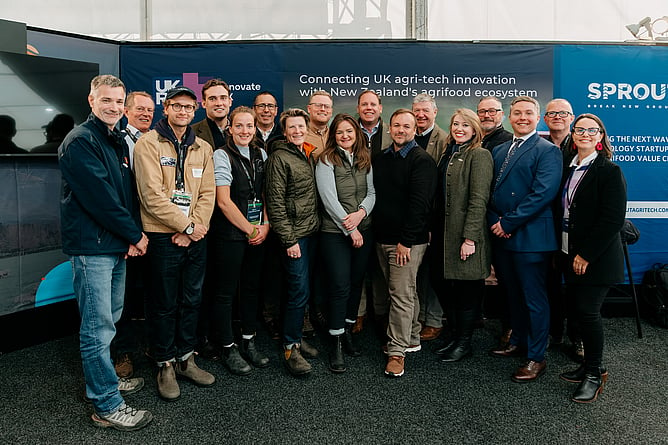
Two Agritech Nations, Different Starting Points
New Zealand and the UK sit on opposite ends of a similar story. New Zealand is a small economy with an outsized agricultural export industry. The UK is a much larger economy with a strong agritech sector, but a food system built mainly to feed itself, and a trade deficit in food to match.
As such, both increasingly see the other as a natural partner.
The UK operates with subsidy and regulatory support running through much of its agricultural sector. New Zealand has had none for decades. Farmers and growers here make every technology adoption decision on commercial logic alone. Will this make me money? Will it save me time? Will it still exist in three years? There's no safety net underwriting a bad bet on new technology, so there's very little appetite for hype.
That single difference shaped almost every conversation the cohort had. More on that below.
On the export side, the scale comparison is striking. New Zealand's food and fibre sector is predicted to generate over NZD $64 billion in export revenue for the year ending June 30, 2026. It accounts for around 80% of the country's total goods exports from a population of five million.
The UK's agritech sector alone, by contrast, turns over more than £13 billion and employs upwards of 25,000 people, in a market more than ten times the population and far more diversified. New Zealand exports almost everything it produces. The UK, comparatively, consumes most of what it grows and imports a large share of its food.
In simple terms, New Zealand has built one of the most efficient export-led agricultural systems in the world, with no subsidy to fall back on.
The UK has built one of the most active agritech innovation ecosystems in the world, with the funding and research infrastructure to back it.
Each has something the other doesn't quite have yet, and that's the premise of this programme.
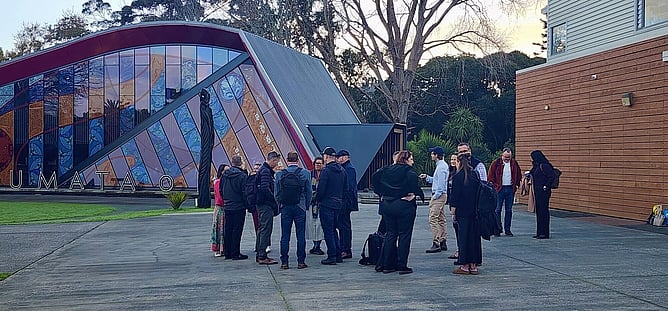
Auckland: The Reality Check
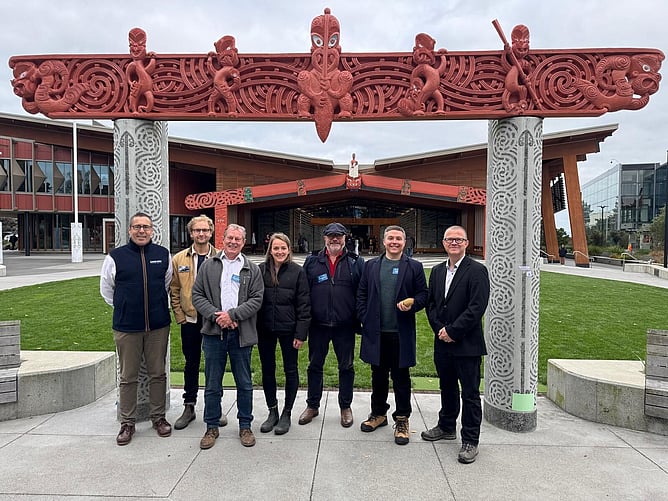
The cohort was welcomed at Te Māhurehure Marae on Monday morning for the programme's official kick-off. The morning briefings did exactly what they were supposed to do: reset expectations.
Brendan O'Connell from AgriTechNZ, Vanessa Winning from the Ministry for Primary Industries, Ruth Leary from AgriZeroNZ and Lee Tejada from Fonterra's R&D team walked the cohort through how the sector runs here in NZ, without subsidy, without protection, purely on commercial outcomes.
One observation that came up again and again from nearly everyone:
"Everyone knows everyone, which is amazing."
In a country this size, six degrees of separation collapses fast.
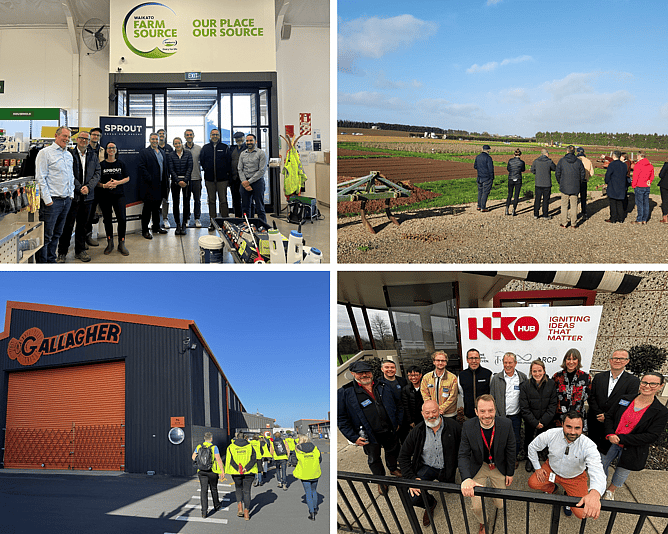
Pukekohe and Waikato: Industry and Agri
The group then ventured from Auckland south to the Waikato. Four stops that together gave an honest picture of what it takes to bring agritech to market in New Zealand.
Starting at Te Ahikawariki, the Vegetable Industry Centre of Excellence at the Balle Bros Group Ltd property in Pukekohe, a working research farm purpose built as a safe place to trial and evaluate technologies at semi-commercial scale.
The message from NZ Vegetable Council (NZVeg)'s Research and Development Manager Daniel Sutton there was clear: NZ growers are time-poor and rely on trusted relationships.
They don't adopt technology because it's interesting. They adopt it because someone they respect has already proved it works in a system they recognise. The annual Vegetable Big Day Out is their answer to that, a hands-on demonstration over slide decks.
From there, the group headed to Gallagher in Hamilton. Sarah Adams and the team walked through their innovation philosophy. Their global scale (14 countries and US market leadership for eShepherd) was a useful reminder that the NZ market is the proving ground not the ceiling, as well as being the source of reliable quality manufactured products.
At the Fonterra Farm Source store in Cambridge, the group saw what farmer-facing distribution looks like at cooperative scale. A single account giving access to fuel, insurance, telecoms, agronomy, technology subsidies, and credit through dry-off. Mark Ennis Head of Category Strategy, Ben Smith Programme Manager (Innovation), Stephen Alexander Category Strategy Manager - Services & Agritech and Shane Laurich Procurement Specialist shared how the farm tech adoption category has grown 80% year-on-year. They also shared that the average farm owner age is 66, however the next generation is coming, and they want to be given tools that work, not just ones that are novel.
The Map of Ag networking event hosted by Chief Technology Officer Andrew Cooke, the cohort heard from innovative farmers adopting next generation farming practices.
Wrapping up at the The University of Waikato's HIKO hub. The group visited the Waikato Robotics, Automation and Sensing Group (WaiRAS), then heard from Kate Wilson from James & Wells IP on IP strategy for companies entering new markets. Kate's shared practical advice: know your sweet spot, do your competitive intelligence research, and treat IP as a dynamic commercial tool, not a filing exercise.
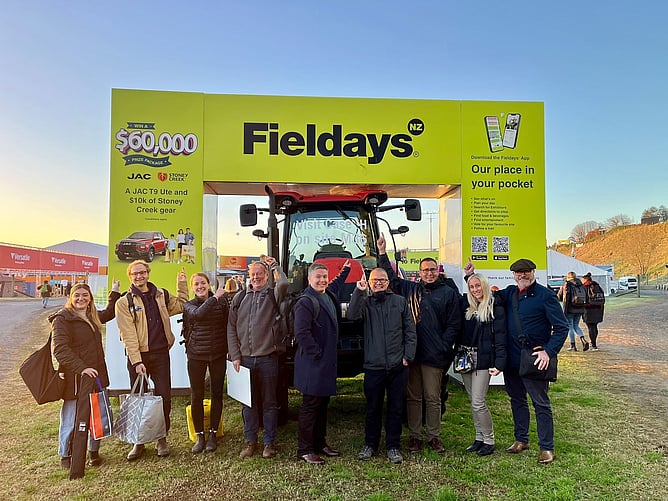
Fieldays: Two Days That Felt Like Weeks
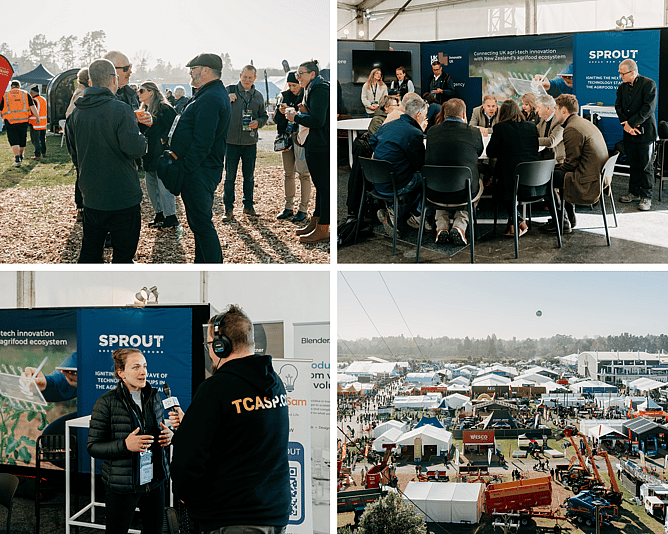
By Wednesday, the cohort was at Mystery Creek for Fieldays, Australasia's largest agricultural event and, by most accounts, an experience that doesn't translate easily into words until you've stood in crisp morning fog yourself.
The cohort took the Tent Talks stage with their lightning pitches, met the visiting UK parliamentary Environment, Food and Rural Affairs (EFRA) Committee delegation at the Sprout and Innovate UK stand in the Innovation Hub, and spent two days in conversations that, by the cohort's own account, were worth more than weeks of cold outreach back home.
When asked by the EFRA Committee what the benefit was to NZ having these UK agritech businesses visit NZ, the reply was:
🌱 NZ might have a large food and fibre export opportunity, which serves as a great proving ground for technology, but our agritech sector is still early in its growth compared to the UK with 1200+ agritech businesses generating over £13 billion in turnover
🌱 The UK is a leading destination for agritech venture capital investment
🌱 The UK's research institutions have real depth, such as Rothamsted Research, the world's oldest agricultural research station and the John Innes Centre, which has been a global leader in plant science since 1909
Across the two days the cohort came away with a string of concrete wins. One company connected with people both interested in trialling their solar panels and involved in setting New Zealand's solar regulations, lined up a local distributor, and fielded interest from barn manufacturers. Another closed a sale straight off the pitch stage, modest in size but real money landed. A third left with multiple parties interested in a 10,000 acre digital twin pilot.
The Bay of Plenty: Where Theory Meets Orchard Floor
From Hamilton, the cohort moved into the Bay of Plenty, a region that exists almost entirely in the orbit of kiwifruit and the port that ships it out.
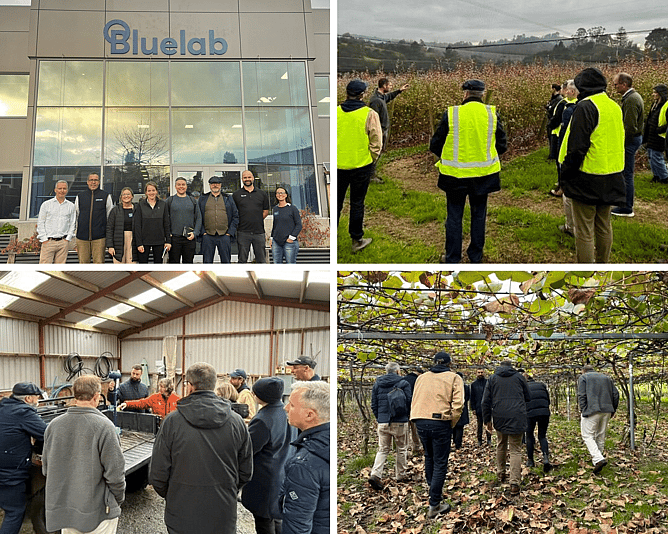
Priority One opened with the regional economic story: a fast-growing, port-anchored economy built on kiwifruit, construction and population growth outpacing most of the country. MPAC followed with a look inside a working packhouse, showing the state of the art grading, sorting, coolstore and dispatch technology behind the Bay of Plenty’s export numbers.
Bluelab, a local horticulture technology manufacturer, then walked the cohort through their hardware and software roadmap, how they’re helping growers make better decisions through measurement, monitoring, and automation and early work reading electrical signals from plants to guide real-time growing decisions.
The cohort then headed up to Katikati to visit a couple of orchards.
KW Kiwi showcased the orchard floor science they’re exploring, sharing information about three years of biochar trial data alongside sap flow sensors and soil moisture probes reading conditions down to 1.8 metres demonstrating a clear rise in stored soil carbon. Darling Group covered their avocado, blueberry and kiwifruit operations, including their vertical supply chain, growing system trials and a twelve month international supply strategy built on hemisphere-spanning partnerships, so they're never relying on a single harvest window.
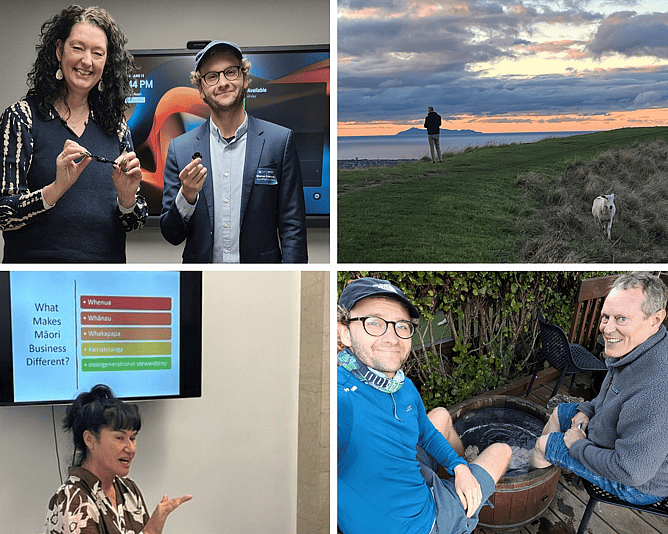
Miro Berries CEO, Liz Te Amo, closed out the region with something most international delegations never get close to, a grounded briefing on the structure and scale of the Māori economy. Liz explained the difference between iwi and individual land trusts, how a Māori asset base of over NZ $100 billion is increasingly moving into housing, energy and infrastructure, and what sets Māori business apart: whenua (land), whānau (family), whakapapa (genealogy), kaitiakitanga (guardianship) and intergenerational stewardship.
A few things stood out to the cohort:
Early-stage propagation of fruiting crops here is genuinely tedious, with long lead times and persistent disease-free stock challenges, reinforcing a belief that strawberries need "a revolution" through hybrid growing systems.
Local blueberry growers turned out to have little overlap with UK problems, keeping plants in the ground for up to thirty years.
Kiwifruit need wind and weather protection against fruit damage, a possible application for technology built for cow sheds.
Schools are helping to build tech capability in the area using locally built STEM kits, and the cohort was encouraged to learn that young people in New Zealand are actively choosing hydroponics as a career pathway, something not necessarily expected back in the UK.
With Tauranga sitting in New Zealand's ‘Golden Triangle’, forecast to be the country's fastest-growing region over the coming decades, the region itself impressed the group as both a holiday destination and a hub for high-value horticulture tech.
Manawatū: A Day with CEDA followed by a visit to Sprout HQ
The Central Economic Development Agency hosted the cohort for a full day in the Manawatū, opening with a regional overview covering the area's food strategy and its claim to be the country's agrifood innovation epicentre, home to Massey University and primary research organisations and some of New Zealand's top agritech companies.
From there, it was straight onto a robotic milking farm, utilising systems that allow cows to voluntarily choose when they get milked. This technology enhances animal welfare, increases milk production, and provides farmers with real-time tracking of herd health. Then the cohort took a tour of Te Utanganui to understand the region's logistics and distribution capability, followed by an afternoon on-farm visit to Hew Dalrymple's Rangitikei property to see the sector's strengths and opportunities firsthand.
The final day in Palmerston North brought together two of the more technical briefings of the trip. Dr. Jason Wargent, founder of Biolumic, walked through their UV-light technology for improving crop performance at the seedling stage.
Christina Moon from the Bioeconomy Science Institute gave an overview of the organisation's work, including a visit to the methane chambers at New Zealand Agricultural Greenhouse Gas Research Centre, where individual animal emissions are measured directly. The day wrapped with lunch at Sprout's Palmerston North HQ, home turf for four of the country's top ten agritech companies, and a fitting place to bring the in-market formal leg to a close.
Insights the cohort picked up from their visit to the Manawatū included:
The Manawatū revealed itself as a logistics and R&D powerhouse, an expanding hub where "all roads lead to Palmy," stretching right onto working farm sites with a mix of crops, livestock and new technology, including automated milking.
Zinc deficiency in New Zealand cattle herds, presented as a real opportunity for HiFe Plant’s breeding programmes.
Palmerston North's appeal as a genuine "15 minute city" for families, bolstered by its cultural diversity, didn't go unnoticed either.
The group then went their separate ways, with a small group extending south to catch up with ChristchurchNZ, the Bioeconomy Science Institute and Plant Research NZ, whilst others headed back north to visit NZ Foodbowl’s batch manufacturing capabilities.
The Six Companies
A quick introduction to who's in this cohort:
Cleobury is tackling one of farming's least glamorous but most expensive problems: nutrient-rich liquid waste. Their on-farm process converts liquid effluent into a storable "super powder" extracting 95% of the water for reuse while retaining nutrient value for fertiliser or animal feed. In New Zealand, Ali and Mandy are working through the local regulatory landscape with a view to running trials that mirror what they've already proven in the UK.
Galebreaker is built around the idea that the environment surrounding livestock matters as much as the pasture itself. Their system combines weather protection, ventilation and smart building controls, with results to back it up: Calf growth rates up more than 25%, labour requirements down 75%, and better resilience to heat stress in dairy cows during hot weather. David is keen to speak to calf rearers and farmers who are exploring new technologies to improve animal health.
GyroPlant has built the GyroCup, a reusable root zone structure designed to replace single-use substrates like rock wool in controlled environment agriculture. Already in use on strawberry, radish and wasabi farms, with applications extending into biomaterials and pharmaceutical growing. Marcus is looking for partners to complete trials in Controlled Environment Agriculture (CEA) as well as talking to House of Science to get GyroPlant’s growing kit into school STEM packages.
HiFe Plants is breeding high-iron pea varieties to tackle the world's most prevalent nutrient deficiency. One in three New Zealand women have insufficient iron, and current solutions like iron tablets come with side effects most people would rather avoid. HiFe's approach builds the nutrition into the crop itself. Jacob is building location research partnerships as well as exploring other crops including lucerne, and is keen to connect with downstream ingredient distributors or supplement manufacturers interested in the technology.
Polysolar has developed flexible solar panels for polytunnels and protected cropping that addresses lack of power available directly in the field for irrigation and automation, leading to higher yield and reduced input costs. Hamish is keen to better understand the New Zealand market as well as look for partners to do trials with.
x10AI build "farm digital twins" combining machine learning, hydrology and remote sensing to track water, carbon, biodiversity and nutrient movement across a piece of land. The goal is to turn environmental stewardship, currently an invisible, unrewarded asset, into something farmers can actually be paid for. Thomas is talking to multiple interested parties about building a 10,000 acre digital twin pilot.
What Travels, and What Doesn't
If there's one thing this visit confirmed, it's that good agritech doesn't transplant in a straight line from one country to another. It has to be tested against a different climate, a different regulatory environment, different crops, different farm sizes, and a farming culture that, as more than one founder discovered, is unlikely to move without proof first.
What does seem to travel well are the underlying problems:
Wasted water and nutrients.
Disease pressure on young plants.
Extreme weather events impacting crops and livestock.
Increasing need for infield power for irrigation, sensors and automation.
Heat stress in dairy cows.
Zinc and iron deficiency.
These aren't unique UK problems or New Zealand problems; they're farming problems, and the solutions developed for one market often need only a few adjustments to be relevant in the other.
What also travels, perhaps better than the technology itself, are the relationships. As Ali Warren-Walker from Cleobury put it,
“The connections made from each of the meetings have been as good as the meetings themselves."
In a country where, as the cohort kept discovering, everyone really does seem to know everyone, that's not a small thing.
Looking Ahead
The cohort now heads home for a four month virtual programme before returning to New Zealand in October. By then, the conversations started in marae meeting rooms, orchard rows, packhouses, dairy farms and methane chambers should have had time to turn into something more concrete. We’re looking forward to hearing more about trial sites, pilot agreements, distributor relationships, and maybe even a few more sales.
New Zealand and the UK have spent decades exporting knowledge to the rest of the world, often in different directions: dairy and meat from one, technology and research from the other.
This programme is a bet that there's a great deal more value sitting in the space between the two markets than either has fully tapped yet.
We'll find out how much in October.