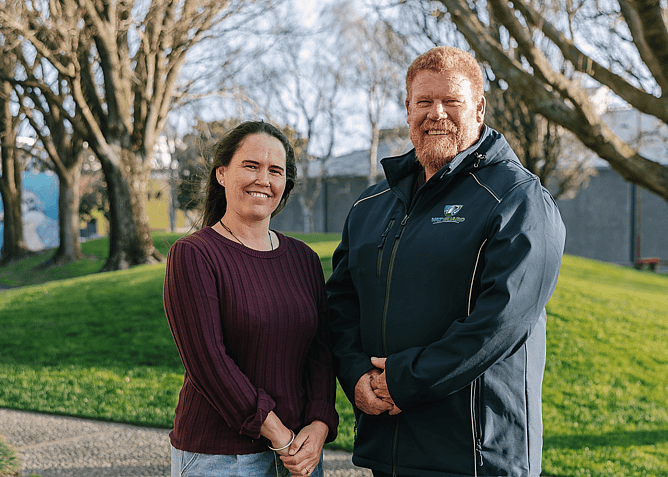
Meet Nathan and Lois Smith, the team behind Vat Guard. They are one of 22 ventures taking part in the Spring26 Cohort of the Sprout Accelerator.
We caught up with them for a quick-fire five questions in five minutes to learn more about Vat Guard and what the venture hopes to achieve from their time in the Sprout Accelerator.
1. Tell us about Vat Guard. What are you building?
Vat Guard was born from a problem we faced on our own dairy farm. After experiencing how one simple human error could contaminate an entire vat of milk and cost thousands of dollars, we knew there had to be a better safeguard.
We developed Vat Guard, a simple wireless visual alert system that clearly shows where the milk is flowing based on the position of the vat tap. It’s designed by dairy farmers, for dairy farmers, to reduce human error, protect milk quality and give farmers greater peace of mind.
2. What problem are you working to solve?
The problem we are tackling is the risk of milk contamination caused by human error during the milking process. On dairy farms, cows that have been treated with antibiotics or whose milk needs to be withheld must be kept out of the vat. But even with good systems, staff training and procedures in place, farming is a busy environment and mistakes can happen. A single mistake can result in an entire vat of milk being contaminated and having to be discarded.
We experienced this problem ourselves. What stood out to us was that there was no simple, highly visible safeguard at the point where the decision really matters - the vat tap. Farmers are often relying on memory, communication between staff, whiteboards and standard operating procedures. Vat Guard adds another layer of protection by providing a clear visual indication throughout the cowshed of where the milk is being directed.
The impact can be significant. A contaminated vat can mean thousands of litres of milk being dumped, lost income for the farmer, additional disposal and clean-up costs, stress for the farm team and, if contaminated milk enters the supply chain, potentially much wider food-safety and reputational consequences.
This matters on a national scale too. New Zealand produced around 21 billion litres of milk in the 2024/25 season from 10,370 dairy herds, generating $27.15 billion in dairy export earnings. More than 95% of New Zealand's milk is exported to over 150 countries, making the integrity and reputation of our milk supply extremely important.
MPI also requires farmers who suspect milk in their bulk tank is contaminated to immediately advise their dairy company and remove the milk from the vat. MPI notes that detections of contaminants above acceptable limits can have serious consequences for both the individual supplier and the processing company.
Vat Guard is about preventing that mistake before it happens, protecting the farmer, the milk processor and ultimately the integrity of New Zealand's milk supply.
3. How does your solution work?
Vat Guard is a simple wireless visual alert system designed to help prevent milk from being accidentally sent to the wrong place during milking.
At the dairy shed, a tap determines whether milk flows into the main milk vat or is diverted away.
Vat Guard monitors the position of that tap and sends a wireless signal to highly visible lights positioned around the dairy shed. This gives everyone working in the shed an immediate visual indication of where the milk is being directed.
The system does not replace the farmer or existing procedures; it simply provides an additional layer of protection against human error. Instead of relying solely on memory, communication or checking the tap, staff have a constant visual reminder throughout milking.
Vat Guard is designed specifically for the farm environment. It is wireless, rechargeable, requires no internet access, and is simple for farmers to install and use.
Ultimately, Vat Guard turns the position of one small but critical tap into an unmistakable visual warning, helping protect thousands of litres of milk from one simple mistake.
4. What is the next important milestone for your venture?
Our next major milestone is taking Vat Guard from a successfully tested prototype into full commercial production.
We have spent several years developing and testing the system in real dairy sheds, and our focus now is finalising the production-ready design, completing the necessary testing and compliance requirements, establishing a reliable manufacturing partner and producing our first commercial batch.
Alongside this, we want to convert the strong farmer interest we have already received into our first commercial sales and build a solid pathway for scaling throughout New Zealand.
5. What are you hoping to get out of your time with Sprout?
We are hoping Sprout can help us bridge the gap between being dairy farmers with a proven solution and building Vat Guard into a successful, scalable business.
We know the farming problem extremely well and have spent years developing and testing Vat Guard in real dairy sheds. Where we would really value Sprout’s support is in commercialisation, particularly manufacturing, product development, market strategy, protecting our IP and building the right industry connections.
During the Sprout Accelerator, we would like to get Vat Guard commercially ready, establish a clear pathway to manufacture at scale and develop a strong go-to-market strategy for New Zealand before looking towards international opportunities.
One thing we have already valued about being part of the Sprout Accelerator is having experienced people challenge our thinking and help us see Vat Guard as more than just a product.
We believe the technology has applications beyond dairy, and we want Sprout to help us build the foundations to take what started as a solution to a problem on our own farm and turn it into a significant New Zealand agritech business.
Find out more: www.vatguard.co.nz