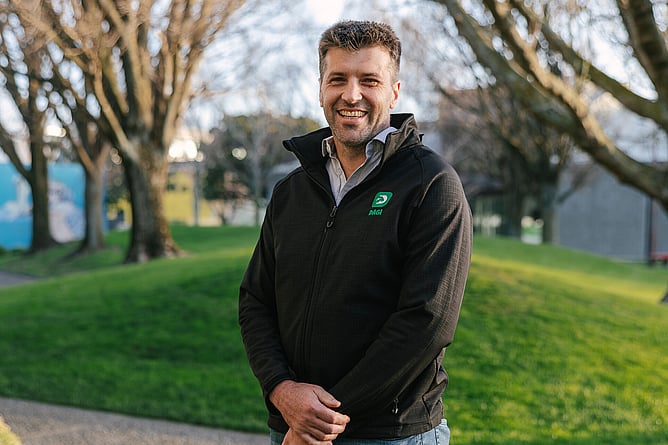
Meet Ryan Luckman, Founder and CEO of DAGI, one of the 22 ventures participating in the Sprout Accelerator Spring26 Cohort.
We caught up with Ryan for a quick-fire five questions in five minutes to learn more about DAGI (Drench and Grazing Integration App) and what he hopes to achieve from his time in the Sprout Accelerator.
1. Tell us about DAGI. What are you building?
I'm a vet, and for 19 years I've watched sheep farmers battle worms. Worms cost them growth, production and, too often, dead lambs. The drenches we've relied on are failing, so the best remaining tool is to keep young stock from eating worm larvae in the first place.
DAGI is an app that makes the invisible visible. It tracks worm contamination across the whole farm, so farmers can put the right stock on the right paddock at the right time. They get faster-growing lambs and less drenching.
2. What problem are you working to solve?
For decades we've let lambs eat lots of worm larvae and then drenched them to clean up the damage. That approach is running out of road. The chemicals are failing as resistance spreads, and we can't keep relying on them.
On top of that, it's a double loss. Even when the drench works, lambs pay for every larva they eat through lost appetite and gut damage. Research-based modelling shows lambs grazing a hot paddock can grow at less than half the rate of lambs on a clean one, around 52 g/day compared with 116 g/day on the same feed. They sell about 6 kg lighter and are worth around $34 less each. For a farm finishing 1,500 lambs, that's about $50,000 a season.
It also helps explain why New Zealand lambs typically grow 80 to 120 g/day after weaning, when the feed in front of them should support 130 to 200 g/day. Avoiding larvae in the first place protects growth and cuts drench use.
3. How does your solution work?
Farmers can't avoid what they can't see. DAGI records mob moves on the farmer's phone and combines that grazing history with the worm lifecycle and local weather. From that, it estimates the larval challenge on every paddock, and gives each paddock and mob a traffic-light rating. When it's time to shift a mob, it's like having a worm consultant in their pocket who knows every move on the farm. Farmers can keep lambs off hot paddocks and save clean ones for when they matter most, while still balancing the feed they have on hand.
4. What is the next important milestone for your venture?
Getting farms on board. DAGI is live now and available to all of New Zealand's ~9,000 sheep farms. Autumn brings the highest larval challenge, just when weaned lambs are most at risk. DAGI builds its picture from each farm's grazing history, so we want as many farms as possible enrolled over spring and summer, ready for when it counts.
5. What are you hoping to get out of your time with Sprout?
I'm a vet who has built a product, so now I need to get better at the parts that aren't animal health: customer acquisition, marketing and support. A clear message that reaches the industry will be what turns a good tool into one farmers actually use.
Find out more: https://www.dagi.nz/
You can also try the larval challenge calculator to see what hot paddocks could be costing your own farm: https://dagi-larval-challenge-cost.netlify.app/